The standard unit is the baseline product across the full size range: the standard flush-free unit , the ADA-compliant wheelchair unit, the flushing deluxe unit with a sink, and the construction-trailer restroom. For a…
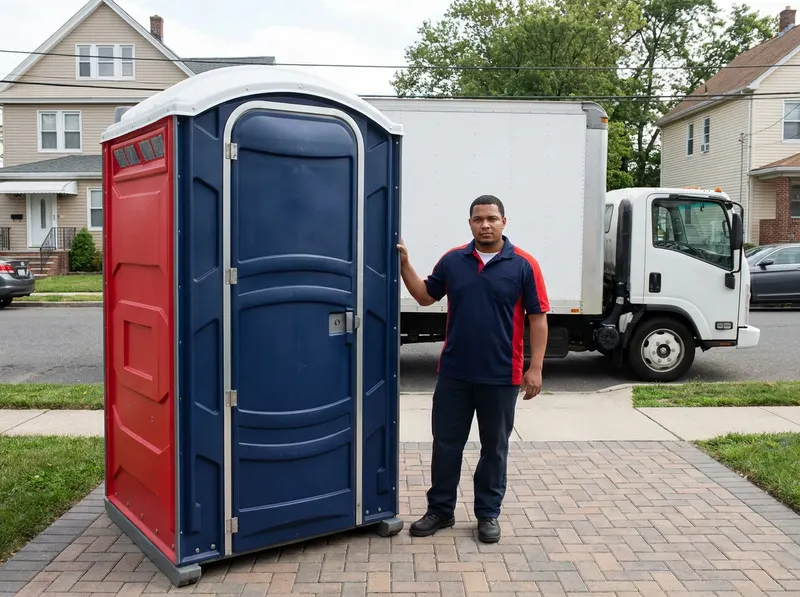
The standard unit is the baseline product across the full size range: the standard flush-free unit, the ADA-compliant wheelchair unit, the flushing deluxe unit with a sink, and the construction-trailer restroom. For a short Newark job or a one-day gathering, the standard unit is the direct fit, a roofing crew off Ferry Street in the Ironbound, a block cleanup in the South Ward, or a backyard party in Vailsburg. The OSHA 1926.51 sanitation standard requires one toilet for crews of 20 or fewer workers, so a single standard unit covers most residential and small-commercial sites in the West Ward and Roseville.
Choosing between options comes down to the people and the ground.
If the site has a wheelchair user or needs to meet public-accommodation access under the Americans with Disabilities Act, the ADA unit with its 60-inch turning radius replaces the standard; for a wedding at a Forest Hill venue near Branch Brook Park, the flushing deluxe with a handwash sink reads better than a basic unit, the trade-off is a higher weekly rate against appearance and hand hygiene. The standard unit wins on cost and on placement speed, since its smaller footprint drops onto a tight University Heights lot or a Central Ward sidewalk corridor that a trailer restroom cannot reach.
Placement follows a short sequence. Step 1: confirm a level, truck-accessible spot within about 50 feet of where the delivery vehicle can park.
Step 2: the unit is set with the door swinging away from foot traffic and anchored on uneven Newark grades. Step 3: weekly service pumps the 60-gallon tank, restocks toilet paper, and sanitizes interior surfaces; the CDC hand-hygiene guidance is the reason a hand-sanitizer dispenser is offered as an add-on. Step 4: at the end of the term the unit is pumped a final time and hauled out.
Waste is disposed of at a licensed facility in line with New Jersey DEP rules, not dumped into storm drains feeding the Passaic River at Riverfront Park.
Hot weather changes the schedule. A unit on a shadeless Weequahic jobsite through a July heat wave needs more frequent pump-outs than one placed in shade near the New Jersey Performing Arts Center; a crowd event at the Prudential Center pushes a single standard unit past capacity fast, so the PSAI ratio of one unit per 10 workers or per 50 event guests is the planning number. The deodorizer charge inside the tank uses a biocide; the firm follows EPA pesticide-registration labeling for the blue treatment and EPA NPDES disposal rules on the back end.
For jobsite stormwater questions tied to a unit near a drain inlet, the OSHA worker-sanitation page and the Essex County public-works office are the authorities to consult.
Every job gets a firm, written price after an on-site visit.
Tell us about your standard portable toilet rental job in Newark and we'll send a clear, written quote, usually the same day.
 Ironbound Portable Toilet Rental